Implementing Change: 4 Ways Technology Is Revolutionizing Implementation Science
Imagine you’re a nurse in a small rural clinic. You slip on a VR headset and receive the exact same hands-on training as a colleague in a top-tier city hospital thousands of miles away.
This is what happens when healthcare innovations actually reach the people who need them — and implementation science is what makes it possible.
Implementation science bridges the gap between research and real-world practice, helping promising healthcare ideas become solutions that work in everyday settings. In this article, we’ll explore four ways digital health tools are fast-tracking the adoption of healthcare innovations.
Digital Health Tools and Implementation Science
The U.S. digital health market is projected to grow by 16.7% annually, topping $1,190 billion by 2032. And adoption is already widespread:
- Over 96% of U.S. non-federal acute care hospitals now use electronic health records (EHRs).
- Health information exchange participation jumped 54% from 2018 to 2023.
But having the technology isn’t enough. Only about 30% of patients are using digital health tools like mental health apps or diabetes trackers. This gap between availability and adoption is exactly what implementation science addresses.
Here are four ways technology is helping close the implementation gap.
#1 Increasing Reach and Health Equity with Telemedicine and Remote Monitoring
A doctor’s visit can now happen from the comfort of your home — or wherever you are.
Telehealth adoption has surged in recent years. In 2024, 74% of surveyed physicians reported working in practices that offer telehealth — tripling the percentage reported in 2018. Physician monitoring through remote or wearable devices grew from 12% in 2016 to 30% in 2022. Physicians have embraced these digital health tools — and for good reason.
Digital health tools enhance the reach and equity of implementation efforts by:
- Bringing care to people in rural or underserved areas
- Closing gaps caused by distance or income
- Supporting key goals in implementation science frameworks like RE-AIM and EPIS, which examine how widely and fairly care is delivered
In fact, a narrative review found that virtual visits can be just as effective for patients as face-to-face appointments.
#2 Boosting Efficiency Through AI Scribes
Imagine your doctor fully focused on you. No frantic typing, no half-listening while wrestling with electronic health records.
An AI scribe is an artificial intelligence tool that runs quietly in the background, taking notes during patient visits and creating documents for later review. And these little bots are pulling their weight: Kaiser Permanente’s AI scribe saved physicians an estimated 15,791 hours of documentation (about 1,794 workdays).
Aside from easing physicians’ mental loads and workflows, AI scribes can also improve patient-doctor communication, especially in paperwork-heavy departments like primary care and mental health treatment.
This matters for implementation science because it:
- Frees up provider time, making new programs easier to roll out
- Increases doctor buy-in by making the job easier
#3 Speeding Up Training and Adoption with VR and AR Technology
You’ve probably heard of the Oculus headset. (Yes, the one for gaming.) But virtual reality headsets aren’t just for gaming anymore. In healthcare, they:
- Treat medical issues like strabismus
- Train medical staff in fully simulated environments (like surgical procedures or emergency protocols)
- Provide scalable and risk-free practice for healthcare professionals
In some cases, VR training has become even more effective than traditional classroom learning. PwC conducted a study showing that VR learners completed training four times faster and felt 275% more confident applying their skills compared to those that studied on-site.
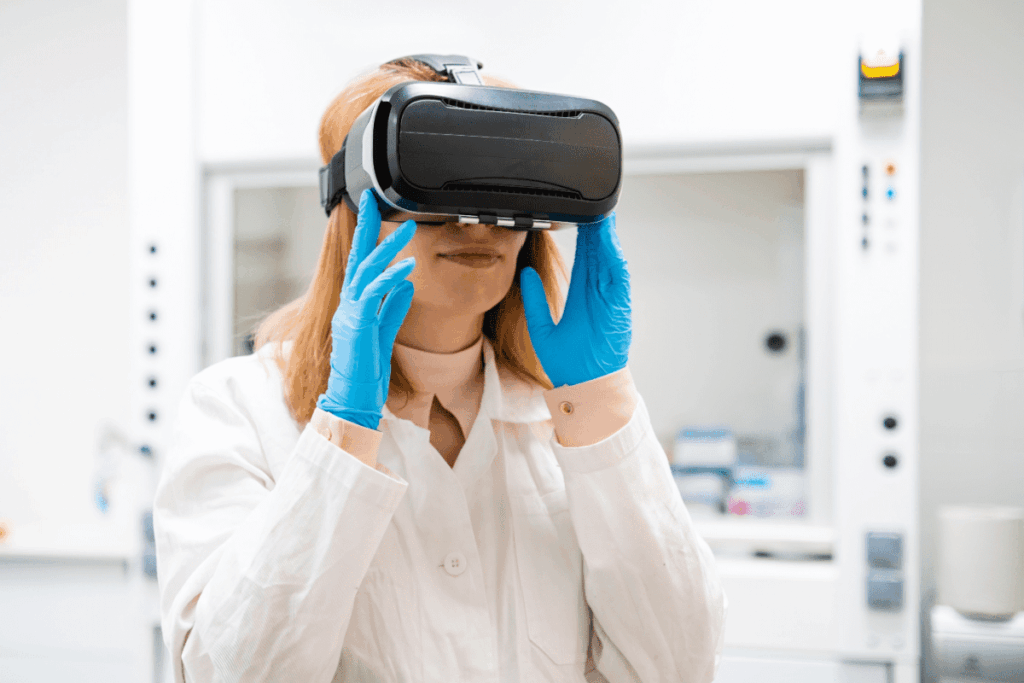
Augmented reality (AR) adds virtual information to real-world experiences: Think smart glasses showing vitals or step-by-step guides during care. AR already powers remote mentorship, where experienced clinicians can virtually coach another provider through real-life procedures.
Quick, efficient training protocols like these:
- Speed up how quickly new skills are learned
- Help ensure staff stick to the new methods
- Maintain ongoing training without flying people across the country
#4 Improving Fidelity and Real-Time Feedback With Digital Monitoring Apps
In implementation science, fidelity means delivering a program the way it was designed. And today, ensuring fidelity is more important than ever. 43% of Americans used a health app in 2024. As these tools reach more people, ensuring they’re used correctly becomes critical.
Traditionally, monitoring fidelity meant labor-intensive observations and manual audits, which can be hard to scale. But digital health tools can now help track fidelity automatically by:
- Tracking patient and provider activities
- Analyzing treatment adherence
- Prompting intervention activities
In mental health care, for example, researchers have developed AI-driven systems that analyze recorded therapy sessions and produce a “report card” showing how closely the clinician followed evidence-based treatment models.
What this means for implementation science:
- Easier quality control
- Scalability: thousands of sessions can be reviewed without extra people
- Better long-term adoption as programs are implemented correctly
The Takeaway
Technology is changing how we bring new ideas into healthcare. It makes implementation faster, more practical and more impactful. In this article, we’ve learned that:
- Patients in rural areas can now connect with care through telehealth and remote monitoring.
- AI scribes are taking notes so providers can focus on people, not paperwork.
- VR and AR are creating hands-on, immersive training experiences.
- Smart apps and monitoring tools are ensuring programs stay true to their design and deliver real results.
Implementation science is about turning great ideas into better care. And with the right technology, the gap between innovation and everyday impact is shrinking.
Turn Evidence Into Action With an Implementation Science Graduate Certificate
If you’re passionate about making healthcare innovations stick — and leading change in your organization — the University of Florida’s online Graduate Certificate in Implementation Science might be your next step.
Our program is fully online and built for busy professionals like you. In just four courses, you’ll master:
- Proven strategies for scaling innovations
- Leading frameworks like RE-AIM and EPIS
- Hands-on tools for real-world implementation
Whether you’re caring for patients, running studies or pushing for better systems, this program gives you practical tools to make change that lasts.
Curious about how far you can go? Learn more about our program before you join Gator Nation.
Sources:
https://impsci.med.ufl.edu/the-technology-adoption-curve-embracing-innovation-in-healthcare/
https://www.uschamber.com/technology/how-virtual-reality-is-transforming-healthcare
https://pmc.ncbi.nlm.nih.gov/articles/PMC6658230
https://pmc.ncbi.nlm.nih.gov/articles/PMC4573926
https://permanente.org/analysis-ai-scribes-save-physicians-time-improve-patient-interactions-and-work-satisfaction
https://pmc.ncbi.nlm.nih.gov/articles/PMC8930782