What Is Rapid-Cycle Evaluation and Adaptation in Healthcare?
Rapid-cycle evaluation and adaptation, or RCEA, is a healthcare improvement method that helps teams test, evaluate and refine interventions in short, repeated cycles. Instead of waiting months to learn whether a program is working, healthcare teams use real-time data and feedback to make small adjustments while the intervention is still in progress.
RCEA became especially relevant during the COVID-19 pandemic, when hospitals and clinics had to adjust quickly to changing guidance, limited resources and overwhelmed systems. In those early days, everything from testing to triage felt chaotic, and healthcare teams needed practical ways to improve workflows without pausing care.
In this article, we’ll explore:
- What RCEA is and how it works
- Key features that make it unique
- The step-by-step process behind RCEA
- When and where it’s most useful in healthcare
How Is RCEA Different From Traditional Evaluation?
Traditional evaluations often look at whether a program worked after it has been fully implemented. RCEA takes a more flexible approach. It allows healthcare teams to evaluate progress while an intervention is still underway, using early data and feedback to make timely adjustments.
That means teams don’t have to wait until the end of a long evaluation period to find out what needs to change. They can test one adjustment, study the results and use what they learn to improve the next cycle.
Key Features of RCEA
RCEA is designed to help healthcare teams make practical improvements without waiting for a long evaluation process to end. Its key features all support the same goal: learning quickly, making informed adjustments and keeping interventions moving in real-world settings.
The Plan–Do–Study–Act (PDSA) Model
At the heart of RCEA is the PDSA cycle, a simple yet powerful framework for continuous improvement. Each cycle includes four steps:
- Plan a small, specific change
- Do or implement that change
- Study the results using quick, real-world data
- Act on what’s learned to either scale up, revise or move in a new direction
This approach keeps evaluations closely tied to practice, so teams are learning and improving as they go — without disrupting the flow of the interventions.
Small, Iterative Cycles
Instead of waiting months or years to see if a large-scale intervention works, RCEA favors short, focused cycles, often just one to four weeks long. These mini-trials allow teams to test one change at a time, respond to feedback and keep building on what works.
Flexible and Responsive by Design
Traditional healthcare interventions can take years to roll out, and they often stall when early results are unclear or mixed. RCEA offers a more flexible approach. Because the intervention is already in motion, teams can quickly adjust based on real-time data.
This flexibility is critical, especially when programs need to show value before stakeholders lose interest or funding is pulled. Everyone involved, from frontline staff to leadership, stays engaged and ready to respond.
How Does Rapid-Cycle Evaluation Work? A Step-by-Step Example
To see how rapid-cycle evaluation works in practice, let’s return to 2020: the height of the COVID-19 pandemic.
Imagine working in a hospital where overwhelmed staff, shifting CDC guidelines and equipment shortages are creating long wait times in the COVID triage and testing area.
Here’s how your hospital team might apply RCEA to quickly respond and improve protocols in real time:
1. Define a Clear Goal
“Can we reduce patient wait times in our triage area by 10% within the next month?”
This question gives the team a specific, measurable target to guide the upcoming changes.
2. Design a Small Change
Rather than overhauling the entire triage process, the team proposes a small adjustment: introducing a short screening questionnaire at the entrance to direct patients more efficiently. This helps identify whether incoming patients need urgent care, routine care or are unlikely to need COVID services.
3. Gather Quick Data
To assess impact, the team keeps data collection simple:
- Staff jot down arrival and triage times on a clipboard.
- Nurses provide informal feedback during shift changes.
These real-time observations help generate early insights without adding an administrative burden.
4. Analyze Rapidly
After just one week, the team reviews the initial results. Wait times decreased by 13%, showing progress. However, some patients had difficulty filling out the form without help.
This kind of quick analysis helps the team adjust course without waiting for a lengthy formal report.
5. Share Findings and Make Adjustments
The team meets to discuss the data and decides to:
- Simplify the language on the form
- Assign a staff member to assist patients at the entrance
These tweaks address the challenges identified during the first cycle, improving clarity and patient experience.
6. Repeat the Cycle
With the revised form and support in place, the team launches a second testing cycle, this time at additional entry points throughout the hospital. If the changes continue to show improvement, they can eventually scale up across the entire facility.
This example highlights the value of rapid-cycle evaluation. Instead of waiting months for traditional evaluations, healthcare teams can test, learn and adapt continuously, making real-time improvements that benefit both staff and patients.
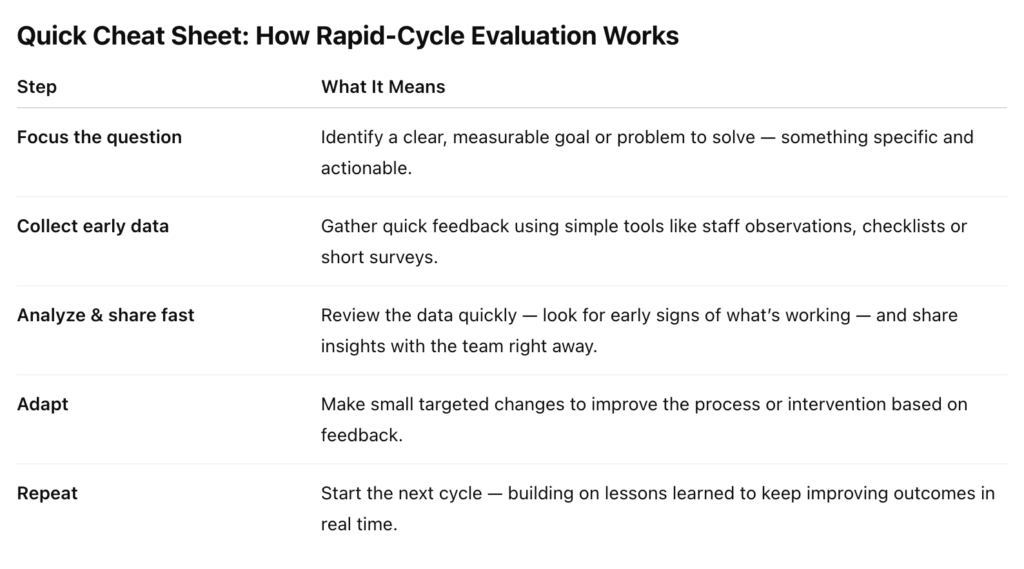
Here’s a simple breakdown of the rapid-cycle evaluation process:
When and Where to Use RCEA
Like any framework, RCEA has its ideal use cases. It’s especially helpful when other evaluation methods might be too slow or costly.
RCEA works best for:
- Refining existing workflows
- New workflows
If an intervention is mostly successful but needs a minor tweak, RCEA lets you improve the part that needs attention while keeping the existing process running smoothly. You don’t need to overhaul everything — just adjust what’s necessary to make the whole system more effective.
- Limited resources
When time or budget constraints limit your options, RCEA offers an effective solution. Some interventions are time-sensitive or don’t have funding for expensive consultants. RCEA provides a cost-efficient alternative, letting teams make data-driven improvements without extra overhead.
Build Practical Evaluation Skills With UF’s Implementation Science Graduate Certificate
With the University of Florida’s online Implementation Science Graduate Certificate, you’ll gain hands-on experience in designing, evaluating and adapting health interventions. The program gives you practical, evidence-based tools to drive real-world improvements in healthcare. Whether you’re a healthcare professional or researcher, this certificate will empower you to create positive change in the field.
Explore our program to learn how you can get started on your application today.
Sources:
https://nirn.fpg.unc.edu/blog/pdsa-cycles-improvement-and-implementation
https://www.ashp.org/-/media/assets/pharmacy-practice/resource-centers/quality-improvement/learn-about-quality-improvement-rapid-cycle-methodology.pdf
Other Articles You May Be Interested In:
- What Was Healthcare Like in the Middle Ages? “Let food be thy medicine and medicine be thy food.” — Hippocrates The Renaissance rewrote the rules of art, science, philosophy and medicine. As these fields flourished, doctors began… Read more: What Was Healthcare Like in the Middle Ages?
- 14 Reasons Healthcare Is So Expensive $5.3 trillion. That’s what the U.S. spent on healthcare in 2024. Premiums, deductibles, copays, the $17 bottle of cough syrup your insurance doesn’t touch: All of it comes with… Read more: 14 Reasons Healthcare Is So Expensive
- How to Win Friends and Influence Healthcare Professionals If you’ve never read Dale Carnegie’s “How to Win Friends and Influence People,” here’s the short version: It’s about getting people on your side without… Read more: How to Win Friends and Influence Healthcare Professionals